Does Your HR Function Make the Grade?
Take our 5-minute quiz and evaluate the effectiveness of your HR function.
LEADERSHIP TRAINING
Self-Study Program
Sign up for the self-study program that has helped hundreds of professionals become four times more productive as a leader or a member of an elite team.
You will have the tools you need to be successful, including the Maximum Accountability book and workbook.
Maximum Accountability Leadership Workshop
This is an on-site workshop. Our team can design the curriculum for aspiring leaders or customise the conversation for experienced leaders.
Participants can choose from one, two, or three day sessions. There is a four-person minimum for participation. The Maximum Accountability book and workbook will be provided for all participants.
Pricing: $2,500 for the first four people, $500 per participant thereafter


Comprehensive Human Resources Services
This is an on-site workshop. Our team can design the curriculum for aspiring leaders or customize the conversation for experienced leaders. Participants can choose from one, two, or three day sessions. There is a four-person minimum for participation. The Maximum Accountability book and workbook will be provided for all participants. Pricing: $2,500 for the first four people, $500 per participant thereafter
“Successfully steering through the specialized HR challenges within organizations of all kinds demands expert understanding, strategic planning, and precise implementation. With comprehensive knowledge of these challenges and the right solutions, your business can stay focused and successful in their vital missions.”
William J. Rizzo

Who we Are.
We Focus on Your HR Needs,
So You Can Focus on Your Mission.
We recognize that proficient management of human resources is fundamental to the success of any enterprise, irrespective of its scale. Our objective is to deliver customized human resource solutions that are in perfect harmony with your distinct business requirements and developmental phase.
Constant Improvement
Commitment to Customers
High Level Of Knowledge
Best Service You Can Get



Building an Employee Onboarding Program That Drives Retention and Performance
Nearly 20% of new hires quit within their first 45 days, often because onboarding failed. Many organizations treat onboarding as paperwork and orientation, then wonder why new hires struggle to adapt or leave shortly after being hired. However, effective onboarding is more than completing paperwork and attending orientation, as it has a significant impact on long-term success.
In consulting, one organization experiencing 30% first-year turnover discovered that the real issue was its onboarding process. New hires lacked structure, support, and clear expectations, making it difficult to feel connected and productive within the company.
A strategic onboarding program reduces turnover, accelerates productivity, and helps new hires become engaged, high-performing employees. This guide explains what effective onboarding looks like, how to build a program that works, and how organizations can measure onboarding success.
What Is Employee Onboarding?
Definition and Scope
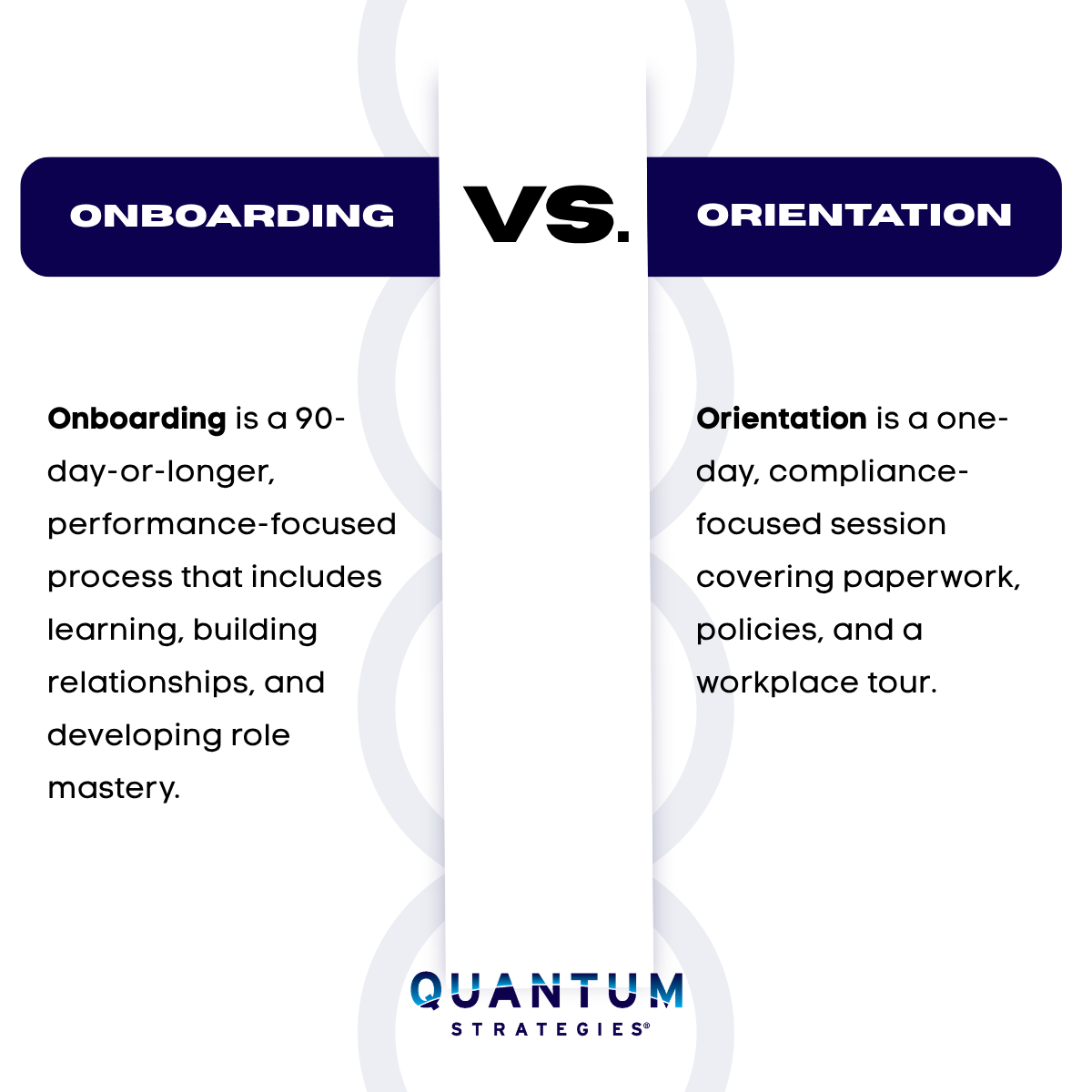
Employee onboarding is the process of integrating new hires into an organization. The purpose of employee onboarding is to help new hires understand their role, the culture, the people, and how to succeed.
Why Most Onboarding Programs Fail
Problem 1: Too Focused on Paperwork
New hires often spend their first day completing paperwork and watching compliance videos, with little meaningful interaction.
Problem 2: No Clear Plan Beyond Day 1
After orientation, new hires are left on their own. Managers are unsure how to support them, while HR focuses on the next hire.
Problem 3: One-Size-Fits-All Approach
The same onboarding is used for both executives and entry-level employees. In addition, remote employees receive the same onboarding as in-office staff.
Problem 4: Lack of Manager Involvement
HR often owns onboarding, and managers assume HR will handle the process. As a result, managers do not check in, provide context, or facilitate building relationships.
Problem 5: Lack of Measurement or Improvement
Companies do not track onboarding effectiveness. As a result, they have no clear insight into whether new hires feel supported or understand expectations.
The Business Case for Strategic Onboarding
The Cost of Poor Onboarding
Organizations with poor onboarding experience 30% first-year turnover, costing 50-200% of annual salary. Without effective onboarding, organizations experience a longer time to productivity and a damaged employer brand.
The ROI of Effective Onboarding
Organizations with effective onboarding retain 82% of new hires. According to SHRM, well-onboarded employees reach productivity 50% faster, while new hires with positive onboarding are three times more likely to be engaged. For example, an organization with 100 new hires per year could reduce first-year turnover from 25% to 15% by improving onboarding, saving $500K or more annually.
What New Hires Need Most
New hires need clarity, connection, competence, and confidence. When onboarding delivers these elements, retention and performance follow.
The 4 Phases of Effective Employee Onboarding
Phase 1 — Preboarding (Offer Acceptance to Day 1)
The goal of preboarding is to keep new hires excited, reduce first-day anxiety, and complete administrative tasks before Day 1. Organizations should send a welcome email from the manager, assign an onboarding mentor, provide a preboarding packet, complete paperwork, and set up equipment.
Phase 2 — Orientation (Day 1 and Week 1)
The goal of orientation is to welcome new hires, integrate them, and set them up for success. On Day 1, managers should greet new hires, introduce them to the team, provide a workspace tour, and review first-week expectations. Throughout the first week, managers should check in daily, answer questions, and provide context.
Phase 3 — Role Mastery (Days 30-60)
The goal of role mastery is for new hires to become competent in their core responsibilities. Managers should conduct a check-in to provide constructive feedback on performance. Additionally, organizations should continue training on key tools, processes, and systems.
Phase 4 — Integration and Performance (Days 60-90)
The goal of integration and performance is for new hires to become fully productive, feel like part of the team, and understand how to succeed. Managers should conduct a review to evaluate performance against expectations and adjust goals if needed.
Building Your Employee Onboarding Program
Step 1: Define Success for Each Role
Not all roles are onboarded the same way; therefore, organizations should set clear 30-, 60-, and 90-day expectations. For example, a sales rep may focus on product knowledge and closing a first deal by Day 60; in contrast, an HR coordinator may master benefits administration by Day 30 and complete a full enrollment cycle by Day 90.
Step 2: Create Role-Specific Onboarding Plans
Create a template that outlines each phase, including preboarding, Week 1, Month 1, Month 2, and Month 3, while including key activities, training, meetings, and milestones.
Step 3: Equip Managers to Onboard Effectively
Managers play the most important role in onboarding; therefore, they must be properly trained. A manager onboarding toolkit includes a role-specific onboarding checklist, a first-day agenda template, 30-60-90 day conversation guides, how to provide feedback, and how to recognize warning signs such as disengagement or confusion. Learn more about an HR leader’s guide to support and retention.
Step 4: Leverage Technology to Scale Onboarding
Onboarding technology automates workflows, checklists, and reminders. Onboarding software tools can enable automated preboarding, new hire portals, manager dashboards, e-signatures, and training module delivery and tracking. Learn more about transforming workplace culture with HR technology, along with details on the custom HRIS design service.
Step 5: Build a Mentor Program
Assign each new hire an onboarding mentor to help answer questions, make introductions, and provide informal support.
Step 6: Create Onboarding Resources
Create centralized onboarding resources with FAQs, how-to guides, policies, and organizational charts, including a video library, role-specific training, and cultural immersion.
Step 7: Measure and Improve Continuously
Survey new hires at 30, 60, and 90 days to understand how onboarding is progressing. In addition, track metrics to measure effectiveness and conduct quarterly reviews to identify patterns, gaps, and areas for improvement.
Onboarding Best Practices
Start Before Day 1
Avoid going silent after offering acceptance, as a lack of communication can increase anxiety. Preboarding helps keep new hires engaged while reducing first-day anxiety.
Make Day 1 About People, Not Paperwork
Move administrative tasks to preboarding. Day 1 should feel welcoming and focused rather than bureaucratic. Additionally, the manager's time with the new hire should be the top priority.
Over-Communicate Expectations
New hires need clarity regarding what is expected of them. Share 30-60-90 day goals in writing and explain how performance will be measured.
Build Connections Early
Introduce new hires to their team, key stakeholders, and cross-functional partners. Encourage informal interactions, such as coffee chats and team lunches, to facilitate building relationships. Early connection is critical, as isolation may drive early turnover.
Provide Quick Wins
Allow new hires to complete a meaningful task in their first week to build confidence. For example, a sales representative might make a first prospecting call, an engineer could fix a small bug, or a marketer may draft a social media post.
Don't Disappear After Week 1
Manager engagement remains critical throughout the first 90 days. Managers should continue weekly check-ins, provide ongoing feedback, and reinforce clear priorities.
Adapt for Remote and Hybrid Employees
Remote onboarding requires effort to build connections, such as virtual coffee chats, video introductions, and company swag deliveries.
Common Onboarding Mistakes and Solutions
Mistake 1: HR Owns Onboarding, Manager Is Disengaged
HR runs orientation, and the manager shows up on Day 1, then disappears. Managers should be the primary owners of onboarding, while HR supports the process with infrastructure.
Mistake 2: Information Overload on Day 1
Many organizations overwhelm new hires with hours of presentations, policies, and compliance videos. Instead, organizations should spread content over several weeks and prioritize human interaction on Day 1.
Mistake 3: No Clear Success Metrics for New Hire
Without clear success metrics, new hires may not understand what strong performance looks like during the first 30, 60, and 90 days. Organizations should provide written expectations and ensure managers discuss goals explicitly.
Mistake 4: Treating All Roles the Same
An engineer receiving the same onboarding as an accountant creates gaps in training and support. Organizations should use role-specific plans based on the position.
Mistake 5: Assuming Onboarding Ends After Orientation
After Day 1 or Week 1, many organizations leave new hires on their own. Instead, onboarding should be a structured 90-day program with checkpoints.
Mistake 6: No Feedback Loop for Improvement
Onboarding programs often stay the same year after year without being updated. Organizations should survey new hires, track metrics, and make quarterly improvements.
Measuring Onboarding Success
New Hire Retention
Measure the percentage of new hires still employed at 90 days, 6 months, and 1 year. Tracking by department, role, and manager helps identify patterns.
Time to Productivity
Measure how long it takes a new hire to reach full productivity, including time to first sale, first project completion, and performance ratings.
New Hire Engagement
Measure through surveys that ask whether new hires feel welcomed, understand expectations, and have the support they need. According to SHRM, gathering such feedback can be useful to evaluate how well new hires are integrating into the workplace.
Manager Satisfaction
Measure by surveying hiring managers on whether onboarding prepared new hires and whether they would recommend the onboarding program.
Onboarding Completion Rates
Track whether managers are completing onboarding activities on time using a dashboard. Low completion rates often indicate that onboarding is not being consistently implemented.
Quality of Hire
Measure by evaluating the performance ratings of new hires at 6 months and 1 year. Organizations should compare the performance of well-onboarded employees with that of poorly onboarded employees.
Real-World Example: Onboarding Program Transformation
A fast-growing tech startup with 120 employees and 40 new hires per year struggled with a 30% first-year turnover rate. New hires felt overwhelmed, managers lacked guidance, and there was no consistent process. The company implemented a structured 90-day onboarding program with preboarding, a manager toolkit, a mentor system, and technology.
After designing the framework, building role-based plans, training managers, and piloting with 10 new hires, the program was fully rolled out. Results included 85% first-year retention, reduced time to productivity, manager satisfaction, and $200K in annual turnover savings.
Onboarding for Different Employee Types
Remote Employees
Ship equipment before Day 1, provide a virtual welcome video from the team, and schedule daily check-ins during the first week.
Hourly and Frontline Workers
Keep onboarding simple and practical, focusing on job tasks, safety, and team culture. Onboarding should be shorter, typically around 30 days instead of 90.
Executives and Senior Leaders
Executive onboarding typically lasts 6-12 months, focusing on stakeholder relationships and strategic context.
Seasonal and Contract Workers
Streamlined onboarding typically lasts 1-2 weeks, focusing on immediate role needs, safety, and compliance.
Conclusion: Onboarding Is an Investment, Not an Expense
Effective onboarding reduces turnover, accelerates performance, and builds engagement from Day 1. Key success factors include manager ownership, a structured 90-day plan, preboarding, technology, and continuous improvement. Don’t treat onboarding as an afterthought, as it is one of the highest-ROI HR programs.
Need help building an onboarding program that drives retention and performance? Quantum Strategies helps organizations design and implement strategic onboarding frameworks. Contact us to schedule a consultation and build an onboarding program that sets your new hires up for success!

Keep Up with Our Latest News and Insights
Subscribe to Quantum Strategies' latest updates and insights.
Quick Links
Home
Help Center
Book a Demo
Contact Us
Office:
Philadelphia, PA | Glen Mills, PA | Washington, DC
Call 610.624.1770
Email:[email protected]
Legal
Privacy Policy
Terms & Conditions
Connect


